admin
admin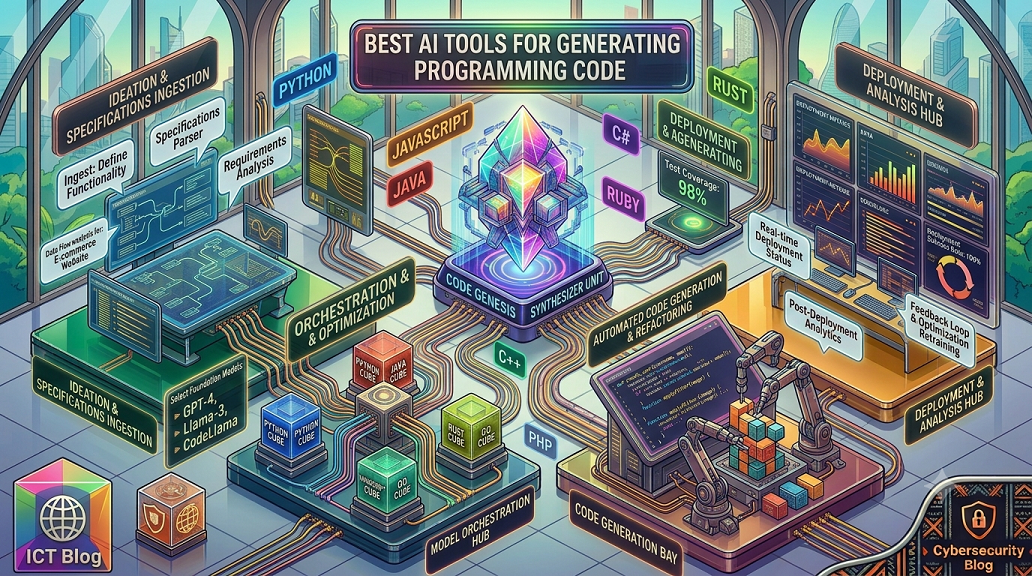
5 Best AI Tools for Generating High-Quality Programming Code in 2026
Artificial Intelligence is reshaping software development at an unprecedented pace. What once required hours of manual coding, debugging, testing, and documentation can now be completed significantly faster with modern AI coding assistants. In 2026, AI-powered programming tools will no longer be experimental technologies used by a few early adopters. They have become essential productivity tools for software engineers, startups, enterprise development teams, cybersecurity professionals, DevOps engineers, students, and technology companies worldwide. From generating backend APIs and frontend interfaces to debugging complex enterprise applications and optimizing cloud infrastructure, AI coding assistants are becoming an integral part of the modern software development lifecycle. The most successful developers today are not asking whether AI will replace programmers. Instead, they are learning how to work alongside AI tools to build better software faster and more efficiently.
This article explores the five best AI programming tools in 2026, their strengths, ideal use cases, advantages, limitations, and practical recommendations for developers and organizations.
Why AI Coding Tools Are Becoming Essential
Modern software projects are becoming increasingly complex.
Developers are expected to work with:
- Frontend frameworks
- Backend APIs
- Databases
- Cloud infrastructure
- Security controls
- Mobile platforms
- CI/CD pipelines
- Container technologies
- Testing frameworks
AI coding tools help reduce this complexity by automating repetitive tasks and accelerating development workflows.
Some organizations report significant productivity improvements when AI coding assistants are integrated properly into development pipelines.
AI can assist developers with:
- Code generation
- Refactoring
- Documentation
- Bug fixing
- Unit testing
- API integration
- Database queries
- Security recommendations
- Performance optimization
Below are the 5 best AI programming tools in 2026 for generating high-quality software code, improving productivity, and accelerating development workflows:
1. ChatGPT
ChatGPT has become one of the most versatile coding assistants available to developers.
Unlike traditional autocomplete tools, it can understand business requirements, architecture discussions, and technical constraints.
Developers use ChatGPT for:
- Full-stack application development
- Code explanations
- Architecture planning
- Debugging
- Refactoring
- Database design
- API development
- Technical documentation
Strengths
- Excellent reasoning capabilities
- Supports multiple programming languages
- Useful for learning and education
- Strong debugging assistance
- Effective for explaining legacy code
Best For
- Startups
- Freelancers
- Full-stack developers
- Technical educators
- Software agencies
2. GitHub Copilot
GitHub Copilot remains one of the most popular AI coding assistants integrated directly into development environments.
Its greatest advantage is its seamless integration with popular IDEs.
Developers can generate code suggestions in real time while typing.
Strengths
- Fast autocomplete suggestions
- IDE integration
- Supports many programming languages
- Excellent for repetitive coding tasks
Best For
- Daily software development
- Enterprise teams
- Backend developers
- Frontend developers
3. Claude
Claude has become increasingly popular among developers working with large codebases and complex software architectures.
Its long context window allows it to analyze entire repositories and maintain context across multiple files.
Strengths
- Excellent long-context understanding
- Strong reasoning capabilities
- Good for refactoring
- Useful for architecture discussions
Best For
- Enterprise applications
- Legacy modernization
- Large software projects
- Technical documentation
4. Google Gemini
Google Gemini has become a powerful development assistant, particularly for organizations working heavily within Google’s ecosystem.
Gemini performs well with cloud-native applications, documentation generation, and infrastructure-related tasks.
Strengths
- Strong integration with cloud technologies
- Excellent documentation capabilities
- Supports large projects
- Useful for research workflows
Best For
- Cloud developers
- Enterprise teams
- Platform engineers
- DevOps teams
5. Cursor
Cursor has rapidly become one of the most popular AI-first development environments.
Unlike traditional editors that simply add AI features, Cursor was designed from the ground up for AI-assisted software engineering.
Strengths
- AI-native development experience
- Context-aware suggestions
- Repository-wide understanding
- Rapid iteration workflows
Best For
- Modern startups
- Product teams
- Independent developers
- Rapid prototyping
Comparison: 5 Best AI Tools for Generating Programming Code in 2026
| Tool | Code Generation | Debugging | Large Codebase Support | IDE Integration | Best For |
|---|---|---|---|---|---|
| ChatGPT | Excellent | Excellent | Excellent | Good | General software development |
| GitHub Copilot | Excellent | Good | Good | Excellent | Daily coding workflows |
| Claude | Excellent | Excellent | Outstanding | Moderate | Enterprise projects |
| Google Gemini | Excellent | Good | Excellent | Good | Cloud development |
| Cursor | Excellent | Excellent | Excellent | Excellent | AI-first development |
Benefits of Using AI Coding Tools
Faster Development Cycles
Projects that once required months may now be completed significantly faster.
Reduced Development Costs
AI reduces time spent on repetitive programming tasks.
Improved Documentation
AI can automatically generate:
- API documentation
- Technical specifications
- User guides
- Code comments
Better Learning Experience
Junior developers can receive explanations and examples instantly.
Improved Productivity
Developers can focus more on solving business problems instead of writing boilerplate code.
Important Limitations
AI-generated code should never be accepted blindly.
Developers must still verify:
- Security
- Performance
- Scalability
- Maintainability
- Compliance requirements
AI can make mistakes, introduce vulnerabilities, or generate inefficient solutions.
Human review remains essential.
Tips for Getting Better Results from AI Coding Tools
Be Specific
Instead of:
Create a login system.
Use:
Create a Laravel 12 authentication system with email verification, role-based permissions, password reset functionality, and CSRF protection.
Generate Small Components
Large applications should be built incrementally.
Generate:
- Authentication modules
- APIs
- Components
- Database models
- Middleware
Request Explanations
Always ask AI to explain:
- Design decisions
- Security considerations
- Performance trade-offs
Review Security
Every AI-generated application should undergo security testing.
Combine Multiple AI Tools
Many professional teams combine multiple assistants to improve output quality and reduce errors.
The Future of AI Programming
The next generation of AI systems will likely assist with:
- Autonomous testing
- Infrastructure deployment
- Architecture generation
- Security auditing
- Legacy system modernization
- Compliance validation
Developers will increasingly become architects, reviewers, and strategic problem solvers rather than writers of every individual line of code.
Final Thoughts
AI coding assistants are becoming one of the most important technologies in modern software engineering.
Organizations that successfully combine human expertise with AI-assisted development will build software faster, reduce operational costs, improve quality, and remain competitive in the rapidly evolving digital economy.
The future of software development belongs to developers who learn how to collaborate effectively with artificial intelligence rather than compete against it.