admin
admin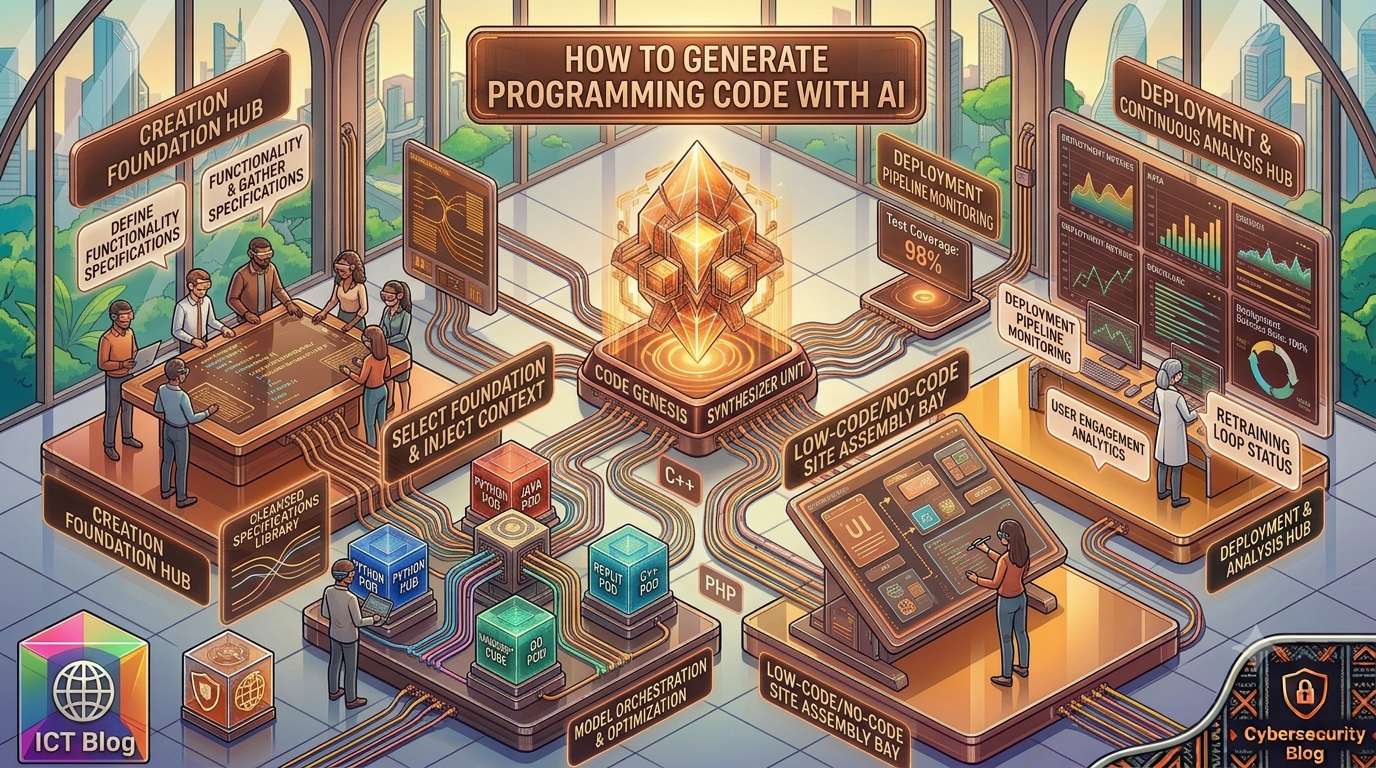
How to Generate Programming Code with AI: A Complete Guide for Custom Software, Web Applications, and Mobile Apps
Artificial Intelligence is fundamentally changing the software development industry. What once required weeks of coding, debugging, documentation, and testing can now be accelerated significantly with modern AI coding assistants. Today, developers, startups, enterprises, agencies, entrepreneurs, and students use AI tools to generate code, automate repetitive tasks, improve software quality, accelerate development cycles, and reduce project costs. From custom enterprise software to responsive websites and mobile applications, AI-powered programming tools have become essential components of modern software engineering workflows. However, successful software development with AI requires understanding both its capabilities and limitations.
This guide explores how AI can generate programming code, the best tools available, practical workflows, benefits, challenges, future trends, and expert recommendations for developers and businesses.
Understanding AI Code Generation
AI code generation refers to the use of machine learning models trained on billions of lines of source code to automatically generate, explain, optimize, debug, and document software code based on natural language instructions.
Instead of writing every line manually, developers can describe requirements such as:
Create a responsive login page using React and Tailwind CSS with email validation and password strength indicators.
An AI coding assistant can generate the initial implementation in seconds.
Modern AI systems can generate:
- Backend APIs
- Frontend interfaces
- Database queries
- Authentication systems
- Mobile applications
- Cloud infrastructure scripts
- Unit tests
- Technical documentation
- DevOps pipelines
- Security recommendations
How AI is Used in Software Development
1. Custom Software Development
Businesses increasingly rely on custom software to automate internal processes and improve productivity.
AI can assist with:
- ERP systems
- CRM platforms
- Inventory management systems
- Healthcare management software
- Financial applications
- Logistics platforms
- HR management systems
AI helps developers rapidly prototype and implement business logic while reducing repetitive coding tasks.
2. Web Development
Modern websites require numerous technologies:
- HTML
- CSS
- JavaScript
- APIs
- Databases
- Authentication
- Responsive design
AI tools can generate:
- Landing pages
- Admin dashboards
- E-commerce websites
- Booking systems
- SaaS platforms
- Customer portals
Developers can focus more on architecture and user experience while AI assists with implementation details.
3. Mobile Application Development
AI is increasingly capable of generating:
- Android applications
- iOS applications
- Cross-platform applications
- Push notification systems
- API integrations
- User authentication systems
Supported technologies include:
- Flutter
- React Native
- Swift
- Kotlin
- Xamarin
Best AI Tools for Generating High-Quality Programming Code
Below are some of the leading AI programming assistants available today.
1. ChatGPT by OpenAI
Best for:
- Full-stack development
- Code explanation
- Debugging
- Architecture planning
- Documentation
Official website:
2. GitHub Copilot
Best for:
- Autocomplete suggestions
- IDE integration
- Repetitive code generation
Official website:
3. Google Gemini
Best for:
- Large codebases
- Cloud applications
- Documentation generation
Official website:
4. Claude
Best for:
- Long-context code analysis
- Architecture reviews
- Refactoring
Official website:
5. Cursor
Best for:
- AI-powered code editing
- Integrated development workflows
Official website:
6. Replit AI
Best for:
- Rapid prototyping
- Learning programming
- Collaborative development
Official website:
7. Amazon CodeWhisperer
Best for:
- AWS development
- Cloud-native applications
Official website:
8. Tabnine
Best for:
- Enterprise environments
- Privacy-focused organizations
Official website:
How to Generate Code with AI (Step-by-Step Guide)
Step 1: Define Requirements Clearly
Poor prompt:
Build an e-commerce website.
Better prompt:
Build a Laravel e-commerce platform with product categories, shopping cart, Stripe payment integration, customer accounts, admin dashboard, inventory tracking, and responsive design.
Detailed prompts generate better results.
Step 2: Select Your Technology Stack
Examples include:
Web Applications
- PHP
- Laravel
- Node.js
- React
- Vue.js
Resources:
Mobile Applications
- Flutter
- React Native
- Kotlin
- Swift
Resources:
Step 3: Generate Small Components First
Generate:
- Login systems
- Authentication middleware
- Database models
- API endpoints
- UI components
Avoid generating entire enterprise applications in one request.
Step 4: Test Every Generated Component
Use automated testing tools:
Step 5: Review Security
AI-generated code must always undergo security reviews.
Common vulnerabilities include:
- SQL Injection
- Cross-site scripting
- Authentication flaws
- Sensitive data exposure
Security resources:
Step 6: Optimize Performance
Evaluate:
- Database queries
- Caching
- Memory usage
- API response times
Performance tools:
Benefits of AI Code Generation
Faster Development
Projects that previously required months may now take weeks.
Reduced Costs
Organizations can reduce repetitive development expenses.
Better Documentation
AI can generate:
- API documentation
- User guides
- Comments
- Technical specifications
Improved Learning
Students can receive explanations and examples instantly.
Increased Productivity
Developers spend more time solving business problems rather than writing boilerplate code.
Challenges and Limitations
AI Can Produce Incorrect Code
Generated code may compile but contain logical errors.
Security Risks
AI does not automatically guarantee secure coding practices.
Technical Debt
Blindly accepting generated code may create maintainability issues.
Licensing Concerns
Organizations should understand the licensing policies of AI-generated code.
Best Practices for Developers
Always Review Code
Never deploy code without review.
Understand Before Using
Developers should understand every generated function.
Use Version Control
Recommended platforms:
Write Effective Prompts
Good prompts include:
- Framework
- Version numbers
- Requirements
- Security requirements
- Performance expectations
Combine Multiple AI Tools
Professional teams often combine:
- ChatGPT
- GitHub Copilot
- Claude
- Cursor
The Future of AI Programming
Over the next decade AI will increasingly assist with:
- Autonomous testing
- Automated architecture design
- Infrastructure deployment
- Security analysis
- Code migration
- Legacy modernization
Software engineers will likely transition from writing every line of code manually to supervising and validating AI-generated solutions.
Educational Resources for Learning AI Programming
Programming Fundamentals
Cloud Development
Open Source Learning
Final Thoughts
Artificial Intelligence is not replacing software developers. Instead, it is transforming software engineering into a more productive, strategic, and creative discipline.
Developers who learn how to collaborate effectively with AI coding tools will build applications faster, reduce costs, improve quality, and remain competitive in the rapidly evolving technology landscape.
The future belongs to developers who combine human creativity, software engineering expertise, and AI-assisted productivity to create the next generation of custom software, web applications, and mobile solutions.