admin
admin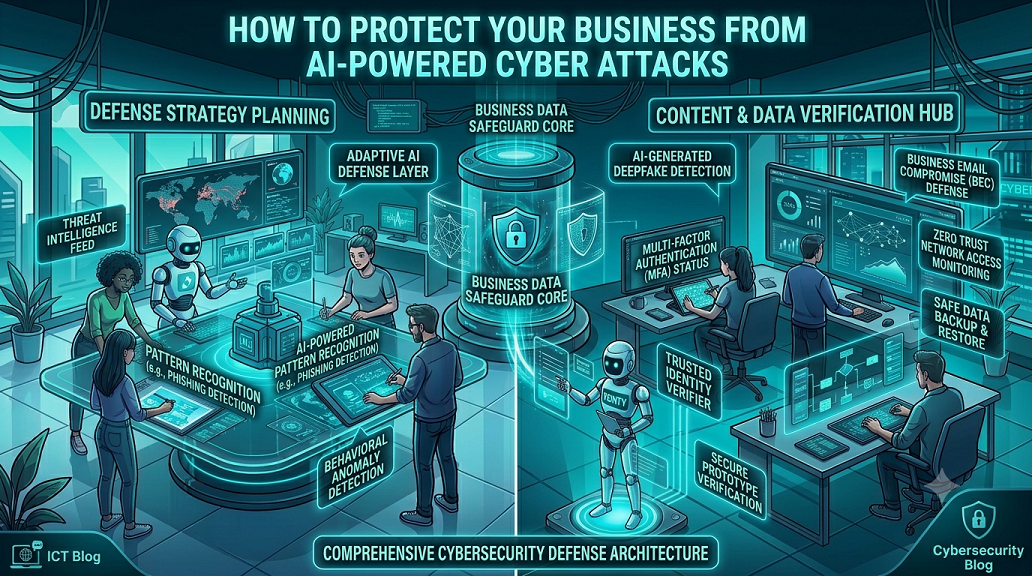
How to Protect Your Business from AI-Powered Cyber Attacks
Artificial Intelligence is revolutionizing business operations, customer service, software development, marketing, and automation. Unfortunately, cybercriminals are also adopting AI technologies to launch faster, smarter, and more convincing cyber attacks. Traditional phishing campaigns that once contained obvious grammatical errors can now be generated by AI in perfect English and personalized for individual employees. Fraudsters can clone voices, create deepfake videos, automate malware development, and launch attacks against thousands of organizations simultaneously.
The rise of AI has fundamentally changed cybersecurity.
Businesses of every size, from startups and local companies to multinational enterprises, must understand how AI-powered cyber attacks work and how to defend against them. This guide explains the major AI threats facing organizations today and provides practical strategies to improve cyber resilience.
Understanding AI-Powered Cyber Attacks
AI-powered cyber attacks are malicious activities that use machine learning and artificial intelligence to improve attack speed, automation, accuracy, and effectiveness.
Unlike traditional attacks that require significant manual effort, AI attacks can:
- Learn from defensive responses.
- Adapt to security controls.
- Scale automatically.
- Personalize attacks against specific victims.
- Operate continuously without human intervention.
These attacks are becoming increasingly difficult to detect using conventional security methods.
Why Businesses Are Attractive Targets
Cybercriminals target businesses because they often possess:
- Customer databases
- Payment information
- Employee records
- Financial documents
- Intellectual property
- Website access credentials
- Cloud infrastructure
- Business emails
Even small businesses are increasingly targeted because attackers often assume they have weaker security defenses.
The Most Common AI-Powered Cyber Attacks
AI-Generated Phishing Emails
Modern AI tools can create highly convincing phishing emails that imitate executives, suppliers, banks, customers, and government agencies.
These messages often include:
- Personalized names
- Accurate company references
- Natural language writing
- Convincing urgency
Employees may struggle to distinguish legitimate communication from fraudulent requests.
Deepfake Voice Fraud
Attackers can clone the voice of:
- Company executives
- Finance directors
- Suppliers
- Customers
An employee may receive a call that appears to come from the CEO requesting an urgent payment transfer.
The voice may sound identical to the real person.
Deepfake Video Attacks
AI-generated video technology allows criminals to create realistic videos that imitate executives or public figures.
Potential uses include:
- Investment fraud
- Brand impersonation
- Corporate misinformation
- Social engineering attacks
AI-Powered Malware
Modern malware can:
- Change its behavior to avoid detection.
- Analyze security controls.
- Identify valuable targets automatically.
- Move laterally through networks.
Traditional antivirus solutions may struggle to identify these threats.
Automated Password Attacks
AI significantly improves:
- Credential stuffing attacks
- Password spraying attacks
- Brute-force attacks
Attackers use stolen credentials from previous breaches to gain access to corporate systems.
AI-Powered Reconnaissance
Before launching attacks, cybercriminals use AI to collect publicly available information from:
- Company websites
- Social media profiles
- Employee biographies
- Job advertisements
- Public documents
This information is then used to create highly targeted attacks.
How to Protect Your Business from AI-Powered Cyber Attacks
1. Enable Multi-Factor Authentication Everywhere
Passwords alone are no longer sufficient.
Enable multi-factor authentication for:
- Email accounts
- Cloud services
- Banking portals
- Website administration panels
- VPN connections
Even if passwords are stolen, attackers cannot easily gain access.
2. Implement Zero Trust Security
Zero Trust follows one principle:
“Never trust, always verify.”
Every user, device, and application must continuously prove its identity before accessing resources.
3. Train Employees Regularly
Human error remains one of the leading causes of successful cyber attacks.
Training should cover:
- Phishing detection
- Social engineering awareness
- Password management
- Safe browsing practices
- Deepfake identification
Security awareness should become part of company culture.
4. Use Password Managers
Strong passwords remain essential.
Employees should avoid:
- Password reuse
- Predictable passwords
- Shared credentials
Password managers can generate and store unique credentials securely.
5. Keep Systems Updated
Many attacks exploit known vulnerabilities.
Regularly update:
- Operating systems
- Web applications
- Plugins
- Firewalls
- Network equipment
- Content management systems
Patch management remains one of the most effective defenses.
6. Segment Your Network
Network segmentation prevents attackers from moving freely across systems after compromising a device.
Separate:
- Accounting systems
- Customer databases
- Production systems
- Development environments
7. Encrypt Sensitive Data
Encryption protects information even if attackers gain access.
Encrypt:
- Databases
- Backups
- File storage
- Cloud repositories
- Email communication
8. Maintain Offline Backups
Ransomware attacks frequently target backups.
Follow the 3-2-1 backup strategy:
- Three copies of data
- Two different storage media
- One offline copy
9. Monitor User Behavior
Behavior analytics can identify unusual activities such as:
- Impossible travel logins
- Large file downloads
- Unauthorized access attempts
- Unusual login times
Early detection significantly reduces damage.
10. Secure Your Supply Chain
Third-party vendors often introduce risk.
Evaluate suppliers based on:
- Security certifications
- Incident history
- Access permissions
- Data handling practices
Advanced Cybersecurity Strategies
Deploy Endpoint Detection and Response (EDR)
EDR systems continuously monitor devices for suspicious activity and automatically isolate compromised endpoints.
Implement Security Information and Event Management (SIEM)
SIEM solutions collect logs from multiple systems and identify suspicious patterns using machine learning.
Adopt Extended Detection and Response (XDR)
XDR combines:
- Endpoint monitoring
- Email security
- Network security
- Cloud protection
This creates a unified view of threats.
Use Threat Intelligence Services
Threat intelligence helps organizations understand:
- Emerging attack trends
- Active malware campaigns
- Industry-specific threats
- Nation-state activity
Perform Regular Penetration Testing
Ethical hackers can identify weaknesses before criminals do.
Penetration testing should occur at least annually.
AI Security for Websites
Website owners should:
- Use Web Application Firewalls.
- Enable HTTPS encryption.
- Restrict administrative access.
- Monitor login attempts.
- Remove unused plugins and themes.
- Enable automatic security updates.
AI Security for Cloud Infrastructure
Cloud environments should implement:
- Identity and Access Management policies.
- Least privilege access.
- Encryption at rest and in transit.
- Continuous monitoring.
- Security posture assessments.
AI Security for Email Systems
Email remains the primary attack vector.
Organizations should deploy:
- SPF records
- DKIM records
- DMARC policies
- Anti-phishing protections
- Attachment scanning
AI Security for Remote Work
Remote employees should use:
- VPN connections
- Managed devices
- Secure Wi-Fi networks
- MFA authentication
- Device encryption
Incident Response Planning
Every organization should prepare for cyber incidents.
A response plan should include:
Preparation
Develop policies and assign responsibilities.
Detection
Identify suspicious activities quickly.
Containment
Prevent the spread of attacks.
Eradication
Remove malicious software and unauthorized access.
Recovery
Restore systems safely.
Lessons Learned
Improve defenses after incidents.
Building a Security Culture
Cybersecurity is not solely an IT responsibility.
Successful organizations encourage:
- Employee awareness
- Executive involvement
- Continuous education
- Security reporting
- Regular exercises and simulations
The Future of AI Cybersecurity
Emerging technologies include:
- Autonomous threat hunting
- AI-powered incident response
- Predictive analytics
- Behavioral biometrics
- Adaptive authentication
Organizations that adopt these technologies responsibly will gain significant advantages in resilience and risk reduction.
Helpful Cybersecurity Resources and External Links
Businesses that want to strengthen their defenses against AI-powered cyber attacks should regularly follow trusted cybersecurity organizations and security frameworks.
Cybersecurity Frameworks and Standards
- National Institute of Standards and Technology (NIST) Cybersecurity Framework
- Center for Internet Security (CIS) Controls
- MITRE ATT&CK Framework
Government and Security Agencies
- Cybersecurity and Infrastructure Security Agency (CISA)
- European Union Agency for Cybersecurity (ENISA)
Website Security Resources
- OWASP Web Security Project
- Cloudflare Learning Center
Breach Monitoring Tools
- Have I Been Pwned
- Google Security Checkup
Security Awareness Training Resources
- SANS Institute Security Awareness
- Microsoft Security Learning Center
Email Security Resources
- DMARC.org
- SPF and DKIM implementation guides
Recommended Security Solutions
- Password managers
- Multi-factor authentication applications
- Endpoint Detection and Response (EDR) platforms
- Security Information and Event Management (SIEM) solutions
You’re right — because the blog content was placed inside a writing block, I couldn’t include clickable external links inside the document itself. You can add the following section outside the article or manually insert it into your CMS after publishing.
Helpful Cybersecurity Resources and External Links
Businesses that want to strengthen their defenses against AI-powered cyber attacks should regularly follow trusted cybersecurity organizations and security frameworks.
Cybersecurity Frameworks and Standards
- National Institute of Standards and Technology (NIST) Cybersecurity Framework
- Center for Internet Security (CIS) Controls
- MITRE ATT&CK Framework
Government and Security Agencies
- Cybersecurity and Infrastructure Security Agency (CISA)
- European Union Agency for Cybersecurity (ENISA)
Website Security Resources
- OWASP Web Security Project
- Cloudflare Learning Center
Breach Monitoring Tools
- Have I Been Pwned
- Google Security Checkup
Security Awareness Training Resources
- SANS Institute Security Awareness
- Microsoft Security Learning Center
Email Security Resources
- DMARC.org
- SPF and DKIM implementation guides
Recommended Security Solutions
- Password managers
- Multi-factor authentication applications
- Endpoint Detection and Response (EDR) platforms
- Security Information and Event Management (SIEM) solutions
Official External Links
- NIST Cybersecurity Framework (NIST CSF)
- Cybersecurity and Infrastructure Security Agency (CISA)
- OWASP Foundation Web Security Project
- MITRE ATT&CK Framework
- Center for Internet Security Controls (CIS Controls)
- European Union Agency for Cybersecurity (ENISA)
- Cloudflare Learning Center
- Google Security Checkup
- Microsoft Security Documentation and Learning Center
- SANS Institute Security Awareness Resources
- Have I Been Pwned Breach Checker
- DMARC Email Authentication Standard
- Google Authenticator
- Microsoft Authenticator
- Bitwarden Password Manager
- 1Password Password Manager
These links will improve the educational value, authority, and SEO strength of your cybersecurity article while providing readers with actionable resources for improving their security posture.
Conclusion
AI is transforming both cybersecurity defense and cybercrime.
Businesses can no longer rely on traditional security measures alone.
Protecting against AI-powered cyber attacks requires a combination of technology, employee awareness, governance, continuous monitoring, and proactive planning.
Organizations that invest in cybersecurity today will be better prepared for the rapidly evolving threat landscape of tomorrow.