
 admin
admin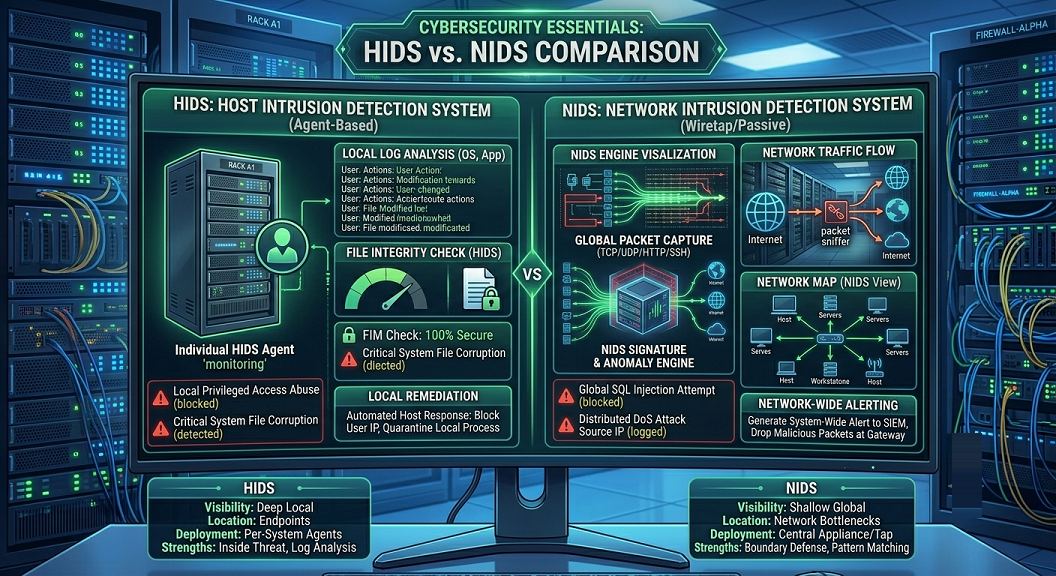
Host-Based Intrusion Detection System vs Network Intrusion Detection System
As cyberattacks continue to evolve, organizations need advanced security mechanisms capable of detecting malicious activities before they cause significant damage. One of the most important components of modern cybersecurity is the Intrusion Detection System (IDS). Intrusion Detection Systems are designed to monitor systems and networks for suspicious activities, unauthorized access attempts, malware infections, and policy violations. They provide early warnings that help security teams respond quickly to threats and minimize damage. The two major categories of IDS are Host Intrusion Detection Systems (HIDS) and Network Intrusion Detection Systems (NIDS). While HIDS focuses on monitoring individual devices, NIDS analyzes network traffic to identify attacks across an entire network.
Understanding the different types of intrusion detection systems and the differences between HIDS and NIDS is essential for building a strong cybersecurity strategy.
What Is an Intrusion Detection System (IDS)?
An Intrusion Detection System (IDS) is a cybersecurity tool that continuously monitors computers, servers, and networks to detect suspicious activities, attacks, and policy violations.
IDS solutions help organizations:
- Detect malware and ransomware attacks.
- Identify unauthorized access attempts.
- Monitor abnormal user behavior.
- Provide security alerts in real time.
- Improve incident response capabilities.
IDS solutions do not normally block attacks directly. Instead, they detect and alert administrators about potential threats.
Types of Intrusion Detection Systems
Intrusion Detection Systems can be classified into two primary categories:
1. Host-Based Intrusion Detection System (HIDS)
Host-Based Intrusion Detection Systems monitor activities occurring on individual devices such as workstations, laptops, servers, and endpoints.
Key Features
- File integrity monitoring
- System log analysis
- User activity monitoring
- Process monitoring
- Malware detection
Advantages
- Deep visibility into endpoint activity.
- Detects insider threats.
- Identifies unauthorized file modifications.
- Monitors system-level attacks.
Limitations
- Must be installed on each device.
- Consumes host resources.
- Difficult to manage in large environments.
Best Host Intrusion Detection Systems (Best HIDS)
OSSEC
OSSEC is one of the most popular open-source HIDS solutions.
Features include:
- Log analysis
- Rootkit detection
- File integrity monitoring
- Real-time alerting
Official Website:
https://www.ossec.net
Wazuh
Wazuh is an enterprise-grade security platform built on OSSEC.
Features:
- Threat detection
- Vulnerability detection
- Compliance monitoring
- Cloud security monitoring
Official Website:
https://wazuh.com
Tripwire
Tripwire focuses on file integrity monitoring and compliance.
Features:
- Configuration management
- Change auditing
- Compliance reporting
- Security monitoring
Official Website:
https://www.tripwire.com
2. Network Intrusion Detection System (NIDS)
Network Intrusion Detection Systems monitor network traffic and inspect packets for malicious behavior.
Key Features
- Packet analysis
- Traffic monitoring
- Signature detection
- Anomaly detection
- Real-time alerts
Advantages
- Protects the entire network.
- Detects external attacks.
- Centralized monitoring.
- Identifies suspicious traffic patterns.
Limitations
- Encrypted traffic may reduce visibility.
- High-speed networks require powerful hardware.
- Cannot inspect endpoint activities deeply.
Best Network Intrusion Detection Systems (Best NIDS)
Snort
Snort is one of the world’s most widely used NIDS solutions.
Features:
- Packet sniffing
- Real-time traffic analysis
- Signature detection
- Protocol analysis
Official Website:
https://www.snort.org
Suricata
Suricata provides high-performance network monitoring.
Features:
- Deep packet inspection
- Multi-threading
- Intrusion detection and prevention
- Network security monitoring
Official Website:
https://suricata.io
Zeek
Zeek provides advanced network analysis and threat detection.
Features:
- Event-based monitoring
- Behavioral analysis
- Traffic inspection
- Protocol analysis
Official Website:
https://zeek.org
Host Intrusion Detection System vs Network Intrusion Detection System
| Feature | HIDS | NIDS |
|---|---|---|
| Monitoring Scope | Individual Devices | Entire Network |
| Data Source | System Logs and Files | Network Packets |
| Detects Insider Threats | Yes | Limited |
| Detects External Attacks | Limited | Excellent |
| Resource Usage | Higher | Lower |
| Visibility | Endpoint Level | Network Level |
Security Tips
- Implement HIDS before deploying NIDS.
- Keep IDS signatures updated.
- Combine IDS with firewalls and antivirus software.
- Monitor logs regularly.
- Conduct vulnerability assessments.
- Use SIEM solutions for centralized monitoring.
- Enable real-time alerts.
- Encrypt sensitive network traffic.
Practical Scenario
Suppose a malicious employee installs unauthorized software on a company server.
A Host Intrusion Detection System (HIDS) detects changes to critical files and sends alerts to administrators.
At the same time, a Network Intrusion Detection System (NIDS) identifies suspicious outbound traffic attempting to communicate with a remote command-and-control server.
By combining HIDS and NIDS, the organization detects both endpoint compromise and network-level malicious activity before major damage occurs.
Final Thoughts
Both Host Intrusion Detection Systems and Network Intrusion Detection Systems are essential components of a layered cybersecurity architecture. While HIDS provides deep visibility into individual systems, NIDS offers comprehensive monitoring across the network.
For maximum protection, organizations should deploy both HIDS and NIDS together. Implementing HIDS first ensures every endpoint is secured before expanding security controls to the entire network.
A combination of IDS, firewalls, antivirus solutions, SIEM platforms, and continuous monitoring provides the strongest defense against modern cyber threats and helps organizations maintain a resilient cybersecurity posture.
Frequently Asked Questions (FAQ)
What are the two main types of intrusion detection systems?
Host-Based Intrusion Detection Systems (HIDS) and Network-Based Intrusion Detection Systems (NIDS).
Which is better, HIDS or NIDS?
Neither is universally better. HIDS protects endpoints, while NIDS protects networks. Using both provides maximum security.
What are the best HIDS tools?
OSSEC, Wazuh, and Tripwire.
What are the best NIDS tools?
Snort, Suricata, and Zeek.
Should IDS be combined with firewalls?
Yes. IDS solutions work best when combined with firewalls, antivirus software, SIEM platforms, and continuous monitoring.
Follow Us
Stay connected with us on social media to receive updates on our latest posts.
Follow us on: Facebook | Instagram



)
)